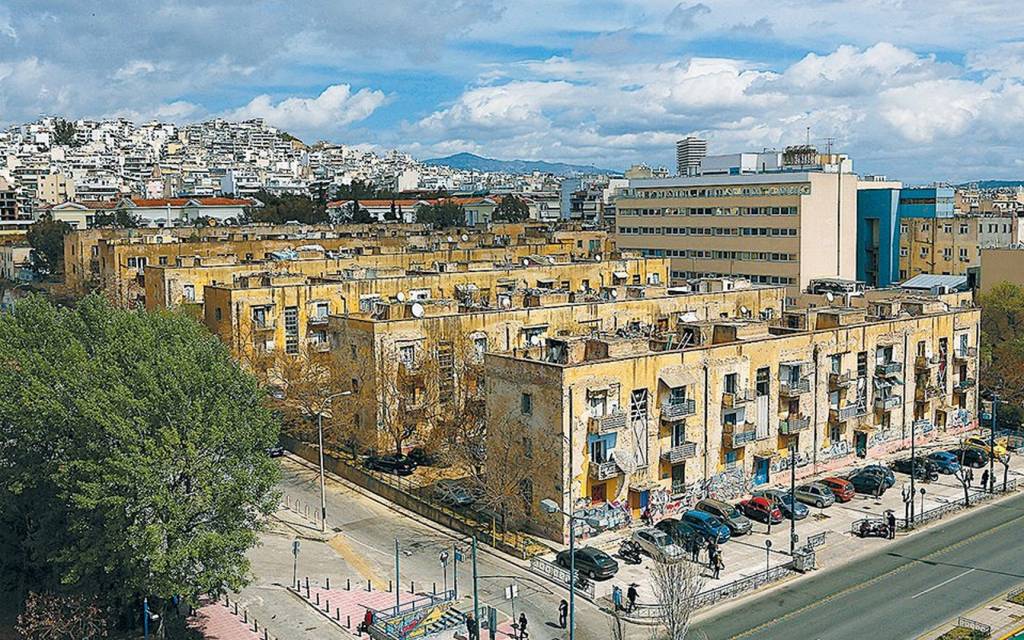
Prosfygika, a powerful example of an urban common. It must be supported.
Silvia Federici, May 2026
I did not know about Prosfygika. Thus, when some feminist friends, knowing my interest in the construction of commons, suggested a visit to it, I imagined we would go to a squatted building. I did not expect to find a self-governed village where for sixteen years four hundred people, from different countries, have lived communally, baking their bread, running classes for their children, making collective decisions in weekly assemblies, fixing the buildings in the eight blocks they occupy. Beside the apartments for the families who live there, the ‘commoners’ of Prosfygika have built a place for meetings, a café, and (most impressive) a bakery where, daily, bread and pastries are cooked. In addition, Prosfygika periodically hosts people who are discharged from the nearby hospital – the largest hospital in Greece for the treatment of cancer – these are people who need a space and help to recover and have no other place to go. And the work of the community is ongoing. The ‘Prosfygikans’ are now preparing an artistic space and, despite the dry terrain, they are collecting compost and planting flowers and vegetables around their homes.
The fact that Prosfygika is located in an area of old Athens that played an important role during the Civil War, as a place where the EAM and ELLAS built their resistance, adds to the significance of the space. On the walls of one of the buildings, one can still see the many holes made by the bullets shot against these patriots. Today Prosfygika continues this struggle for democracy, in the very place that gave the name to this form of government and civic coexistence.
But once again the community is facing a serious threat, as a program of gentrification is underway that, if it succeeds, would displace it and destroy all that the inhabitant of Prosfygika have built and achieved. The prospect is heartbreaking since, added to the suffering of the people displaced, who include elderly, people whose health is precarious and children, there would be the defeat of a project that stands as an example of ‘buen vivir’ – an example of what is possible when people join their efforts and, instead of fighting each other, learn to take responsibility for each others’ lives.
Two people are now on a hunger strike to dramatize the seriousness of the situation and tell the city government and all the people of Athens and beyond that what is at stake in Prosfygika is a true matter of life and death and not for them alone.
Aristotelis Chantzis has been on a hunger strike now for 86 days. His life is in danger and yet he is prepared to die not to see this community destroyed.
He has now been joined by Suson Doppagne, who is part of the women structure of Prosfygika. Both Aristotelis and Suson are young people, with many years of life ahead of them, yet they are ready to die for a world in which the lives of people are not sacrificed for sake of commercial interests, where the memory of the past is preserved, and where our solidarity extends to those who have come and struggled before us to create a better world.
Let’s not allow that these brave people be sacrificed. In a world where every day more violence structures human relations, and where, increasingly, we live like self-contained islands, places like Prosfygika are important not only to their inhabitants but to us all. There are places where we can taste not only a great bread, but what it means to live a life governed by solidarity and the recognition of our essential interdependence.
Let’s join the effort to both convince the Region of Attica to desist from its plan to displace the residents of Prosfygika, to observe the rule of law, and to ensure that this powerful example of communal living, social cooperation, and direct democracy is allowed to continue and thrive.
Silvia Federici, Athens,
May 13, 2026
Prosfygika under threat: “We need to escalate the struggle”