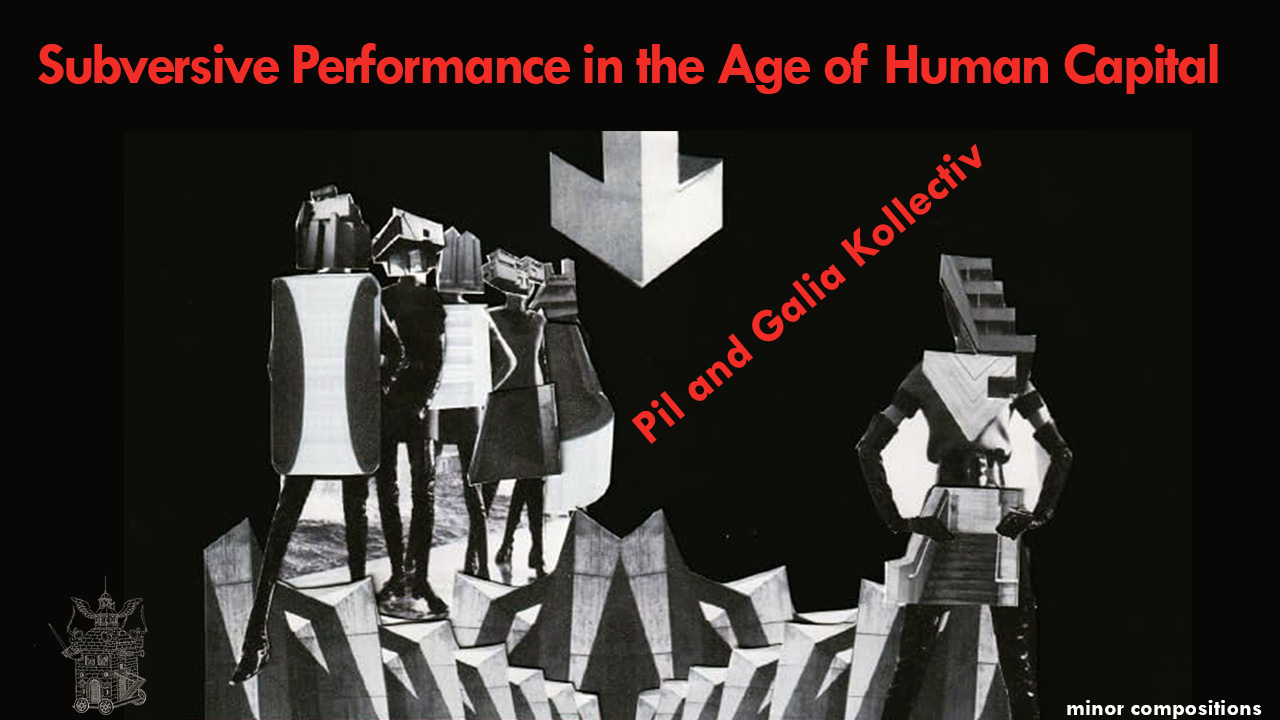
In this episode we chat with Pil and Galia Kollectiv to explore their new book, Subversive Performance in the Age of Human Capital. Stevphen was originally to take part in the book release event last autumn in London but was unable. So instead we’ve turned that missed event into an excuse for a conversation around Pil and Galia’s work. Topics covered include intersections of performance, labor, and neoliberal culture, examining how artistic expression resists and reframes the commodification of human potential.
“Contemporary art relies on an expansionist, modernist ideal and still progresses through a critique of earlier forms of democratisation. But beneath this democratic drive, lurks a creeping crisis. Under neoliberalism, criticality has become a zone of value production. A self-deprecating irony, exposing and re-enacting this position of impotence, is one of the few gestures left in the arsenal of critical art. Against this irony, this book pits overidentification. This term has been taken to mean a kind of parodic mimicry of institutional power. Using a broad tapestry of sources, from political philosophers to art theorists, from post-Marxist critiques of labour to ethnographic studies, it proposes an interpretation of overidentification that does not collapse into ironic posturing. The authors differentiate this from bad faith flirting with taboo aesthetics by focusing on practices grounded in a genuine identification with power that ushers the kind of excess implied by overidentification. It is these forms of overidentification that destabilise the metastasis of liberal-democracy. Staging forms of critique not so readily absorbed into the structure of the present, these subversive performances herald a future beyond the democratic paradox.”
Bio: Pil and Galia Kollectiv are artists, writers and curators working in collaboration. They lecture in Art at the University of Reading, Royal College of Art and University of the Arts London.
Leave a Reply